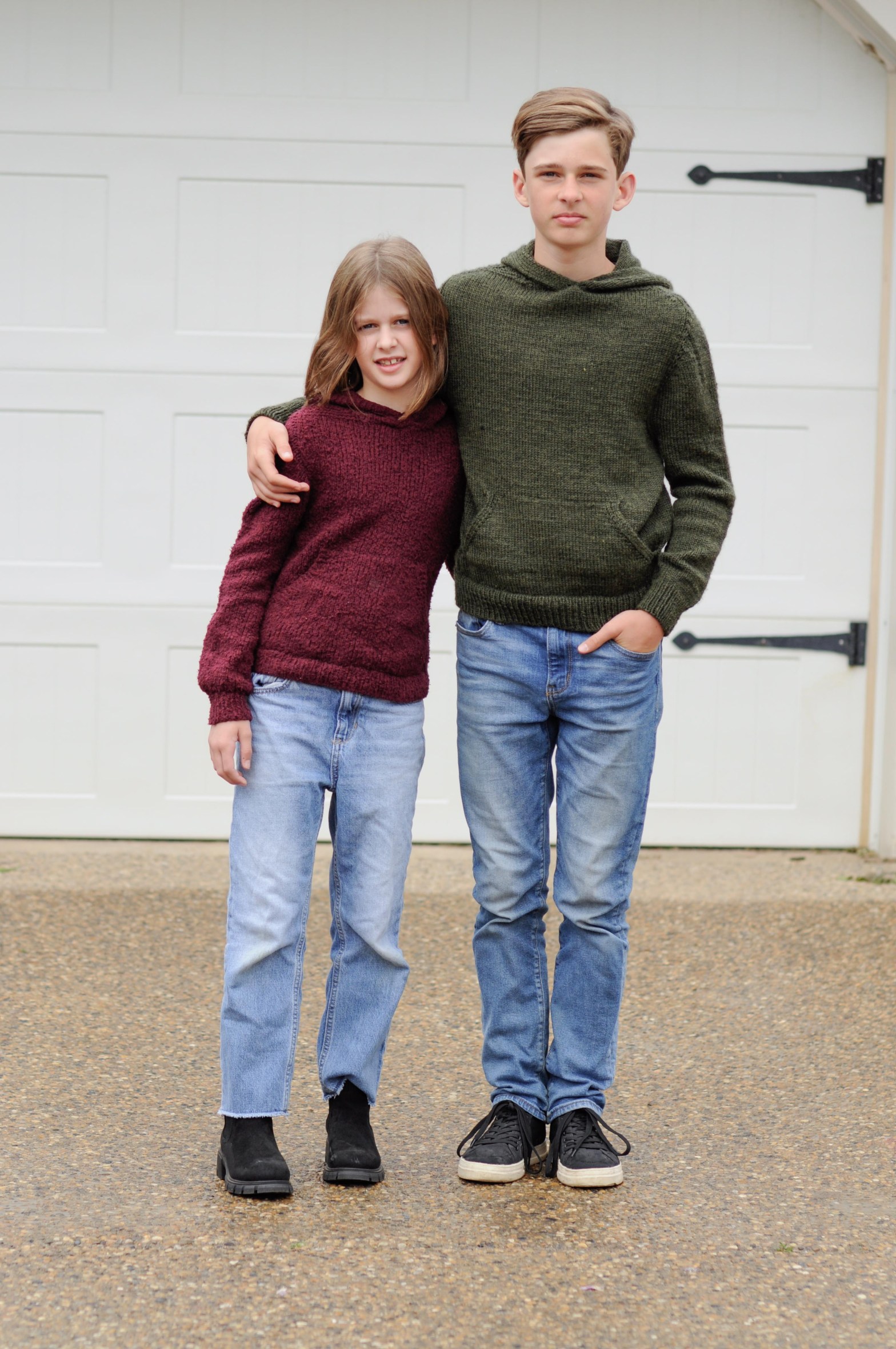
What feels like not so long ago, I used to knit primarily for my four children. As they’ve grown, however, they’ve had little desire for knitwear in their wardrobe. Although they loyally wear their Musselburgh hats throughout the winter, they do not wear any knit garments (all but my youngest, who happens to be the most knitworthy person I know).
All that changed when I drafted this hoodie for my daughter. She is extremely particular about what she wears, so if she wears something I’ve knit (of her own free will), it is guaranteed that she actually likes it! On top of her stamp of approval, my other three children requested their own versions. Quadruple win!


That is how the Homegrown Hoodie was born. At this time, I have completed three out of four hoodies, with just my youngest’s left to work up. We went shopping together at our local yarn store (Statement Junkie) and they were left to pick out their yarn and colour. Two kids chose Estelle Worsted, a worsted-weight combination of acrylic and wool. I was pleasantly surprised by how nice it was to work with. Except for the static the yarn seemed to create, causing it to cling to everything as I was knitting, the yarn is not squeaky, like acrylic tends to be, and also washes and wears really nicely. The kids chose it because they found it soft to the touch and because it comes in so many colours, so they were able to find a shade they both loved. As an advocate of wool in clothing, I don’t tend to use acrylic for my knitwear; HOWEVER, if including acrylic in a yarn blend allows a recipient to actually use and wear the garment, and if some wool is also included in the blend, I feel it is a small step in the right direction. Additionally, Estelle is a Canadian owned company, which I can get behind.

So let’s get into the details of this design, as it may be a construction method you have not come across before. It is a seamless set-in-sleeve design with compound increases that is worked from the top-down as a yoked pullover, with increases placed strategically to provide an ideal fit in the shoulders, chest and sleeves. Beginning at the back neck and working flat, the yoke is increased at four points similar to a raglan yoke, to create the back and both front panels, while simultaneously shaping the neckline.
Once the neckline is shaped, the garment is joined to work in the round and the sleeve shaping is done within the yoke. The garment is divided for sleeves and body and the body is worked straight in stockinette until stitches are put on hold and sections are worked separately to shape the front and liner of the pocket. The sleeves are seamlessly shaped in the round as one piece to the cuffs. In final steps, the neckline is picked up to work the hood, with overlapping front edges. The entire garment is worked primarily in stockinette, with some garter to aid shaping the shoulder lines, and ribbed edges throughout.


I have put abundant effort into creating Progress Trackers for each size for this pattern. These tables help the knitter keep track of stitch counts per section, since more than one section is being increased at the same time within the yoke of the sweater. That means you know the total stitch count, but also how many stitches should be on the front or back panels, or how many should be within the sleeves, at any point within the yoke. This is how I prefer to work while I knit, and I have found that knitters really appreciate this extra addition to the pattern.


I hope you enjoy the Homegrown Hoodie! I love to see and share your projects on Instagram! If you like, you can tag them with @the.bluebird.box and #HomegrownHoodie. Uploading a project page to Ravelry is great too. Thank you for supporting my creative work!
Much love,
Anna.
